
The 3% Rule in B2B Sales & Marketing: Why Most Companies Ignore 97% of their Market

Updated: Sep 24
TL;DR: The widely used 3% Rule suggests that roughly 3% of an addressable B2B audience may be actively looking for a solution at a given time, while the remaining 97% is either problem-aware but not ready, researching, satisfied with an existing provider, or not currently interested. For founders and CXOs, the implication is significant: sustainable pipeline growth comes from building trust with the 97% before they enter their buying cycle.
Timestamps:
0:00 - The Invisible Marketing Mistake
1:03 - My Experience: Closing $75M in Enterprise Sales
1:32 - The 3% Rule Explained (The 5 Market Segments)
3:10 - Why Chasing Only Hot Leads Compresses Your Margins
4:28 - Actionable Playbook: How to Market to All 5 Segments
4:42 - Segment 1: The 3% (Remove Friction)
5:15 - Segment 2: The 7% (Nurture Without Pitching)
5:46 - Segment 3: The 30% Who Recognize the Need (Educate via Personal Branding)
6:30 - Segment 4: The 30% With No Current Need (Stay in Peripheral Vision)
7:14 - Segment 5: The Disinterested 30% (Let Them Go & Filter Leads)
8:02 - The Ultimate Secret to Brand Dominance
What Is the 3% Rule in B2B Marketing?
The 3% Rule is a B2B market segmentation concept popularized by sales and marketing practitioners to illustrate a simple reality: most of your potential customers are not ready to buy from you today.
The exact percentages should not be treated as a universal scientific measurement. Market composition varies by industry, product, category and buying cycle. But the underlying principle is highly relevant to our thinking on B2B sales and trust: if your entire go-to-market strategy is designed around people who are actively buying right now, you are competing for the smallest and most contested part of your market.
Those active buyers are already being approached by your competitors. They are comparing vendors, evaluating pricing, reviewing case studies and negotiating terms. That makes the active-buyer segment commercially attractive, but also intensely competitive. The bigger opportunity is what happens before a prospect starts looking for a vendor.
The 3% Rule: Understanding the Other 97%
For practical B2B marketing, the market can be viewed as five broad groups.
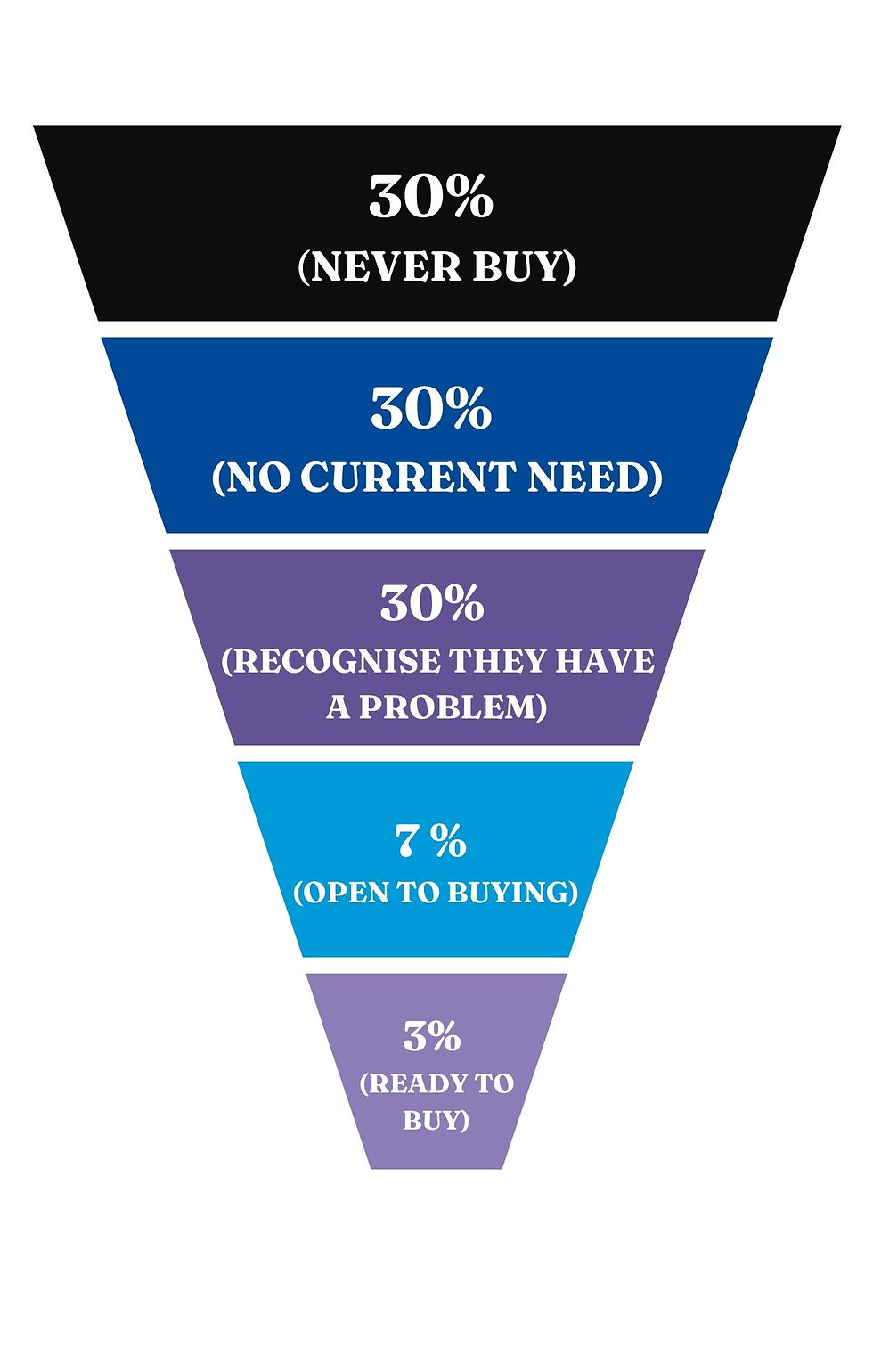
The 3% active buyers are already looking for a solution and have a relatively immediate requirement. The 7% near-term buyers have a problem and may be considering solutions, but haven't necessarily entered a formal buying process. The next 30% problem-aware prospects recognize a challenge but don't yet have sufficient urgency to act. Another 30% are future prospects who may not currently perceive a problem but could enter the market when their circumstances change. The final 30% are currently unlikely to buy, either because they are poorly aligned with your offering or simply have no relevant need.
The percentages are directional rather than mathematical laws. Their strategic value is in forcing a different question:
What are you doing with the 97% who aren't ready to buy today?
The $75 Million Sales Lesson: Deals Are Often Won Before the RFP
This isn't simply a marketing theory for me. Across enterprise sales roles at Wipro, SAP and IBM, I was involved in more than $75 million in closed enterprise transactions. One of the strongest patterns I observed was that large B2B deals were rarely won at the moment the customer issued an RFP.
By then, much of the decision had already been shaped. The vendor's credibility had been established. Relationships had been developed. The customer had formed perceptions about the company's expertise. Internal stakeholders had already heard the vendor's name. In many cases, the sales conversation was simply the visible part of a much longer process.
That is why I think the most important part of B2B marketing happens in the middle of the funnel, long before the prospect raises their hand.
Marketing's job isn't simply to generate leads. It is to make sure that when the prospect eventually becomes a lead, you are already familiar to them.
How Should B2B Companies Build Content for All 5 Segments?
1. Convert the 3% Active Buyers With Frictionless Execution
Active buyers don't need a 2,000-word explanation of why their problem exists. They already know they have a problem. They need evidence that you can solve it.
This is where specific case studies, customer outcomes, product demonstrations, implementation details, testimonials and clear next steps become critical. Your website and sales process should make it easy for a qualified buyer to understand what you do, why they should trust you and what happens next.
The objective here is conversion, not education.
2. Nurture the 7% With High-Value Outreach
The next group has a problem but isn't necessarily ready to sign a contract. This is where aggressive sales messaging can become counterproductive.
Instead, give them a reason to continue the relationship. Share relevant research, industry observations, benchmark data, useful audits or insights specific to their business. Targeted email and LinkedIn outreach can work particularly well when the message provides genuine value rather than immediately asking for a meeting.
You are not trying to close the prospect today. You are trying to earn the right to have the conversation later.
3. Educate the 30% Through Founder-Led Branding
This is where founder branding becomes particularly powerful. A prospect may recognize that something isn't working but may not yet understand the size of the problem, its underlying cause or what a better solution looks like. A founder who can articulate that problem clearly can create demand before the prospect begins actively searching for vendors.
Long-form videos, podcasts, detailed LinkedIn posts, industry analysis, executive perspectives and research-led articles can all play a role here. The objective isn't to repeatedly say, "Buy from us."
It is to make the prospect think, "These people understand my problem better than most companies in this space."
That is the beginning of authority.
4. Maintain Peripheral Vision With the Next 30%
The next 30% may not have a pressing problem today. That doesn't mean they are irrelevant. A business can go from "we're fine" to "we need help" remarkably quickly. A new competitor enters the market. A key employee leaves. Revenue stalls. A regulation changes. An investor demands growth. A technology disrupts the category.
When that happens, the prospect suddenly moves into a buying cycle. The companies that win these conversations are often not the companies that appeared yesterday. They are the companies the buyer has been seeing, hearing and mentally cataloging for months.
This is why consistent newsletters, podcasts, professional content, founder visibility and useful educational material matter. You are building familiarity before you need it.
5. Disqualify the Final 30%
Not everyone should become a customer. Trying to convince fundamentally unsuitable prospects to buy from you consumes sales bandwidth, creates fulfillment problems and can ultimately damage your positioning.
Strong B2B marketing therefore needs a qualification layer. Your messaging should make it increasingly obvious who your ideal customer is, what problems you solve and who you are not designed to serve.
If there's one thing I can guarantee after closing $75 million in business over 14 years, "Disqualification isn't a failure of marketing. It is a sign of maturity."
The 27-Touchpoint Principle: Why Consistency Matters
One of the patterns I repeatedly observed during my enterprise sales career was that meaningful B2B relationships rarely developed through a single interaction.
A prospect might encounter a salesperson through an email, then see their LinkedIn profile, hear their company mentioned by a colleague, attend a webinar, read an article, receive another communication and eventually have a direct conversation. The individual touchpoints may appear insignificant, but collectively they create familiarity.
I refer to this as the 27-touchpoint principle: the idea that significant enterprise decisions often require repeated exposure and multiple trust-building interactions before a buyer is ready to engage seriously.
I would not treat 27 as a universal number. The actual number varies enormously by category and deal complexity. The important principle is repeated credibility before the buying moment. Thought leadership, podcast appearances, founder content, PR, newsletters and sales outreach can therefore work as parts of the same system rather than as disconnected marketing activities.
Why Founder Branding Can Accelerate B2B Sales
Corporate content establishes what a company does.
Founder content can demonstrate how its leadership thinks.
That distinction becomes particularly important in complex B2B categories where the buyer is not simply purchasing a product. They are taking a risk on a vendor, its people and its ability to deliver.
A founder who consistently shares informed perspectives, explains industry shifts, discusses real customer problems and demonstrates hard-earned experience can create a layer of trust that conventional corporate advertising struggles to replicate.
This is why founder branding should not be treated as a vanity exercise. Done properly, it becomes part of the sales infrastructure.
When the prospect finally enters the 3% active-buying segment, your founder may already be familiar to them. Your company may already be associated with a particular expertise. Your content may already have answered some of their questions.
The sales team isn't starting from zero. They are starting from trust.
The Real B2B Marketing Advantage Is Being Chosen Before You Are Compared
The biggest mistake I've seen B2B companies make over my 2-decade long sales career with the 3% Rule is treating the other 97% as irrelevant. They aren't irrelevant. They simply aren't ready.
The job of marketing is therefore not just to capture existing demand. It is also to build familiarity, educate the market, establish authority and create preference so that when demand eventually emerges, your company is already in the consideration set.
My experience across more than $75 million in enterprise transactions reinforced this repeatedly: the most valuable sales conversations often begin long before the first formal sales conversation.
Don't wait for the 3% to start looking for you. Build enough authority with the 97% that they remember you when they do.
A real Brain Box Catalysts case study shows this in practice. how a sales leader turned LinkedIn personal branding into a sales asset. The engagement combined LinkedIn outreach, sales content, technology expertise, video and client proof to strengthen commercial credibility.
This is also where deliberate middle-of-funnel marketing becomes important: the objective is to build enough understanding and credibility that the eventual sales conversation starts with context rather than from zero.
Frequently Asked Questions About the 3% Rule in B2B Sales
What is the 3% Rule in B2B marketing?
The 3% Rule is a commonly used B2B marketing framework suggesting that only a small percentage of a target market is actively looking to purchase at any given time. The exact percentage varies by market, but the principle is that most potential buyers are not currently in-market.
What Should You Do With the Other 97%?
The other 97% needs a different relationship with your brand. Consistent content, founder visibility, PR, educational material and thoughtful outreach can build familiarity and trust before buying intent appears.
Why should B2B companies market to prospects who aren't ready to buy?
Because today's non-buyers can become tomorrow's active buyers. Consistent content and thought leadership allow companies to establish familiarity and credibility before a prospect enters a formal buying process.
How does founder branding support B2B sales?
Founder branding can establish trust and demonstrate expertise before a prospect has a direct sales conversation. Consistent founder-led content can help prospects associate an individual and their company with a particular area of expertise, making future sales conversations easier.
What is the 27-touchpoint principle?
The 27-touchpoint principle is a practical sales observation that significant B2B buying decisions often require repeated interactions before a prospect is ready to engage seriously. The number 27 should not be interpreted as a universal benchmark; the underlying principle is that complex B2B sales require consistent exposure and trust-building over time.
Should B2B companies focus on leads or brand building?
They need both. Lead generation captures existing demand, while brand building and thought leadership create familiarity and preference among prospects who are not yet ready to buy. A strong B2B growth system connects the two.
About Brain Box Catalysts
Brain Box Catalysts helps founders, leaders and businesses build visibility, authority and trust through personal branding, PR, content and media. The focus is not simply on publishing more content, but on building an interconnected body of evidence that makes expertise easier to discover, understand and trust.


